• Home
  • Artwork
    • Artists
    • Themes
    • Latest Stock
  • Exhibitions
  • Videos
  • News
  • About
  • Contact
  • Home
  • Artwork
    • Artists
    • Themes
    • Latest Stock
  • Exhibitions
  • Videos
  • News
  • About
  • Contact
Artmob
SALE
Featured Image 1
Winter sale 2026
Featured Image 2
Winter sale 2026
Featured Image 3
Winter sale 2026
Artmob
AM 21907/23 Julie

Julie Nangala Robertson

Serial:

AM 21907/23
Title: Mina Mina Jukurrpa (Mina Mina Dreaming)
Created: 2023
Medium:
Acrylic on Belgian linen

Size:

1820 x 1520mm

$14,300 (tax inc.)

SOLD

Purchase enquiry

The story:

Mina Mina is an extremely important ceremonial site for Napangardi and Napanangka women that is located approximately 600kms west of Yuendumu, just east of Lake Mackay and the WA border. Mina Mina has a ‘marluri’ (salt lake or claypan) that is usually dry, without water. There are also a number of ‘mulju’ (soakages), sandhills, and a large stand of ‘kurrkara’ (desert oaks [Allocasuarina decaisneana]). The Mina Mina Jukurrpa is an important source of Warlpiri ritual knowledge and social organisation, particularly relating to the different roles performed by men and women.

The ‘kirda’ (owners) of this country are Napangardi/Napanangka women and Japangardi/Japanangka men, who can depict portions of the Mina Mina Jukurrpa in their paintings. The artists mother, Dorothy Napangardi (c.1956–2013) painted Mina Mina and has passed down her Jukurrpa stories to her children and asked them to continue to paint for her. There are a number of different components of the Mina Mina Jukurrpa; artists usually choose to depict one particular aspect. These can include ‘karnta’ (women), ‘karlangu’ (digging sticks), ‘majardi’ (hairstring skirts/tassels), ‘ngalyipi’ (snakevine [Tinospora smilacina]), ‘jintiparnta’ (desert truffle [Elderia arenivaga]), and ‘kurrkara’ (desert oak [Allocasuarina decaisneana]).

In ancestral times a group of ‘karnta’ (women) traveled from Mina Mina on an epic journey to the east. These ancestral women danced at Mina Mina and ‘karlangu’ (digging sticks) rose up out of the ground. They collected these digging sticks and started travelling to the east. They carried their digging sticks over their shoulders and they were adorned with ‘majardi’ (hairstring belts), white feathers, and necklaces made from ‘yinirnti’ (bean tree [Erythrina vespertilio]) seeds.
They travelled east from Mina Mina, dancing, digging for bush tucker, and creating many places as they went. As they went east, they passed through Kimayi (a stand of ‘kurrkara’ (desert oak)). They passed through sandhill country where the ‘yarla’ (bush potato or ‘big yam’ [Ipomea costata]) ancestors from Yumurrpa and the ‘ngarlajiyi’ (pencil yam or ‘small yam’ [Vigna lanceolata]) ancestors from Yumurrpa were engaged in a huge battle over women. This battle is also a very important Warlpiri Jukurrpa narrative. The women went on to Janyinki and stopped at Wakakurrku (Mala Bore), where they stuck their digging sticks in the ground.
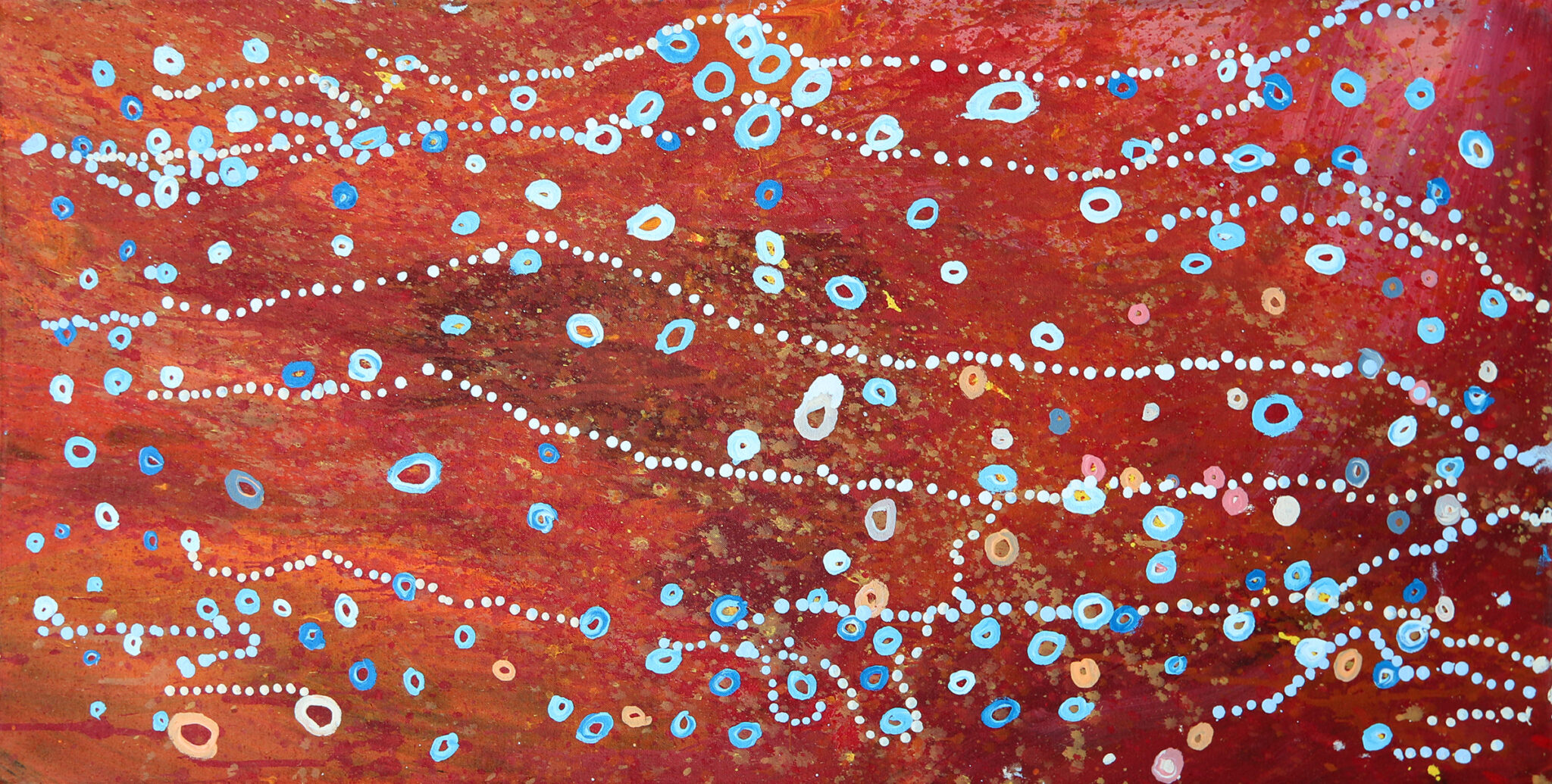
These digging sticks turned into mulga trees, which still grow at Wakakurrku today. The women then went on to Lungkardajarra (Rich Bore), where they looked back towards their country in the west and started to feel homesick for what they’d left behind. The women split up at Lungkardajarra. Some of them travelled eastwards to Yarungkanyi (Mount Doreen), and kept going east. They passed through Coniston in Anmatyerre country, and then went on to Alcoota and Aileron and beyond. The other group of women travelled travelled northwards from Lungkardajarra to Karntakurlangu. These women stopped at Karntakurlangu to dig for ‘wardapi’ (sand monitor/goanna [Varanus gouldii]) and ‘jintiparnta’ (desert truffle) before going further north. Both groups eventually got so homesick for their desert oak country in the west that they went all the way back to Mina Mina, where they stayed for good. The dots in this painting represent the women as they walked and danced across the country.

PrevPreviousAM 21908/23
NextAM 21675/23Next

Related artwork:

Related products

Get in touch
  • 29 Hunter St, Hobart 7000,
    Tasmania, Australia
  • +61 3 6236 9200
  • euan@artmob.com.au
Subscribe to our newsletter
Sign up
We accept:

Cash – locally only – up to $10,000 only. Layby facilities available. Card details can be advised securely using WhatsApp.

We pay our respects to the elders past and present of the Palawa people on whose land Art Mob operates.

© Art Mob Pty Ltd, Aboriginal Fine Art Dealer, all rights reserved.

Disclaimer | Privacy | Terms & Conditions

Indigenous Art Code Dealer

Purchase enquiry

  • Home
  • Artwork
    • Artists
    • Themes
    • Latest Stock
  • Exhibitions
  • Videos
  • News
  • About
  • Contact
  • Home
  • Artwork
    • Artists
    • Themes
    • Latest Stock
  • Exhibitions
  • Videos
  • News
  • About
  • Contact

Subscribe to our newsletter