
Serial:
AM 16751/19
Title:
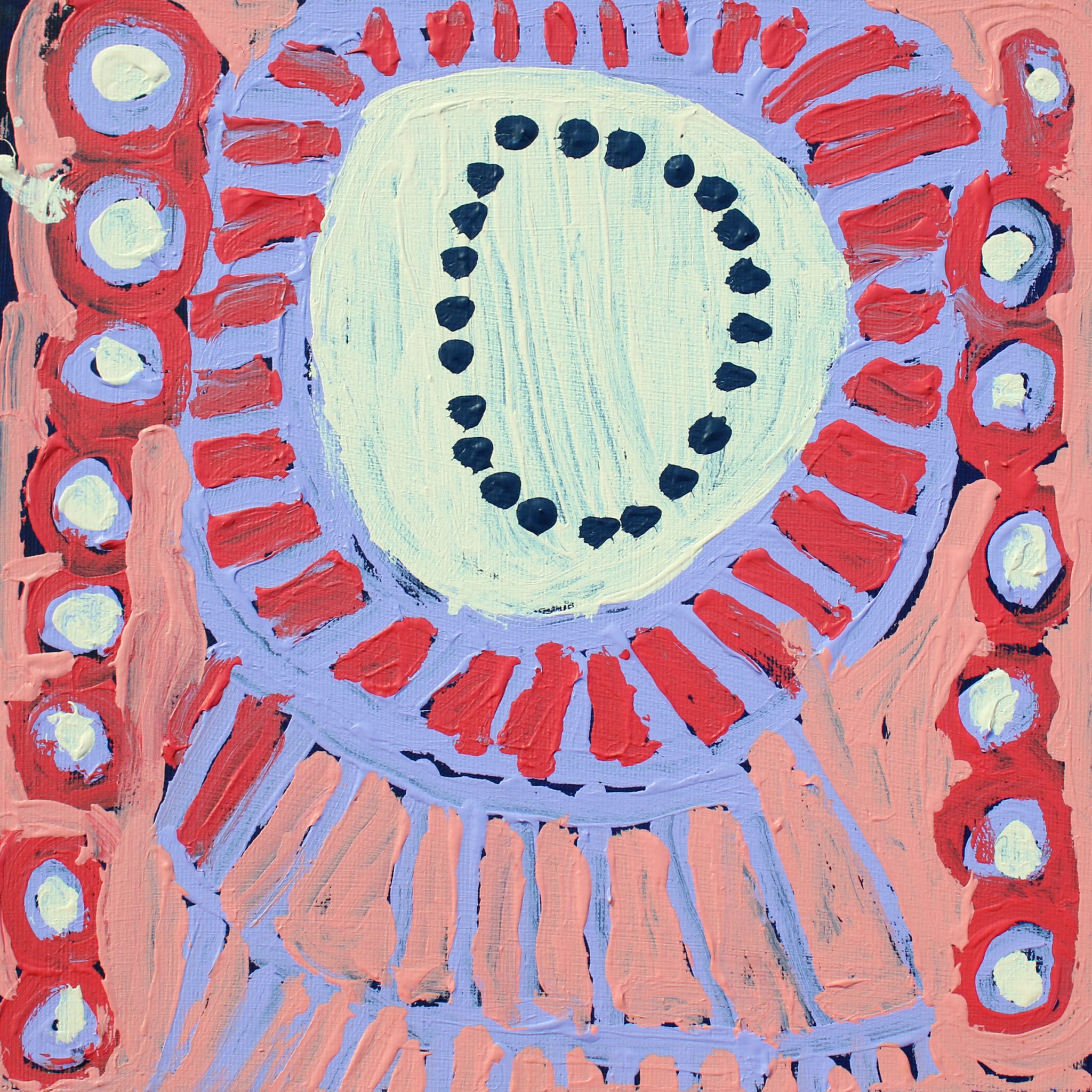
Malikijarra Jukurrpa (Two Dogs Dreaming)
Created:
2019
Medium:
Size:
300 x 300mm
$250 (tax inc.)
SOLD
The story:
This painting depicts ‘malikijarra Jukurrpa’ (two dogs Dreaming). The ‘kirda’ (owners) of this Dreaming are Nampijinpa/Nangala women and Jampijinpa/Jangala men. This Dreaming comes from country adjacent to the windmill at Warlarla (Rabbit Flat). This site is part of a long Dreaming track that stretches from Yarrajalpa in the extreme west of Warlpiri country to Warlaku (Ali Curung) in the east. In this Dreaming story, two dog ancestors, a Jampijinpa and a Napangardi, travelled from the west to the east. They began at Yarrajalpa (a waterhole) and travelled through Wirninginpa, Jinarli, Karljawarnu (a rockhole), Jilwirrpa, and Waanjurna (a rockhole). They dug holes in the ground and created ‘warnirri’ (rockholes) and ‘ngapa’ (waterholes) as they went. At Tapu (a rockhole), the two dogs separated. The female dog, Napangardi, went to the south towards Ngamarnawarnu. The male dog, Jampijinpa, went to the north through Mukirri and Paruwu. Eventually he became lonely and howled for Napangardi in the south. She came running to him, and they married each other at Ngarnka. They wore men’s and women’s marriage headdresses, and Jampijinpa painted himself with white clay for the ceremony. After the wedding, they continued on slowly to the east through Kurduwijawija, Warlarla (Rabbit Flat), and Yurlpuwarnu (rockholes). At Yurlpuwarnu they started a fire using a ‘jimanypa’ (stick), a spear-thrower, and ‘yinirnti’ (bat-wing coral tree [Erythrina vespertilio]) wood for firewood. The dogs then continued east through Kulpurlunu (a waterhole) and Ngumurlungu, where they encountered some other dogs. However, these dogs sent them away while they performed a sacred ceremony. The two dogs continued running east, past Jarramarda and Yankirrikirlangu, before arriving in Warlaku (Ali Curung). Many other dogs were living in Warlaku when they arrived. There were many families of dogs, mothers and fathers and children and uncles all living together. Jampijinpa and Napangardi made a burrow to rest in and started a big family of dogs there. They chose to stay in Warlaku and live with all the other dogs. In this way, the ‘malikijarra Jukurrpa’ (two dogs Dreaming) tells the story of proper conduct in families and marriages. In Warlpiri paintings, traditional iconography is used to represent the Jukurrpa and other elements. The ribcages of the Jampijinpa, Napangardi, and their family of dogs are depicted in this work. Their ribs can also be seen as features in the landscape in the Yankirrikirlangu area. Concentric circles are used to represent the ‘ngapa’ (waterholes) around Yankirrikirlangu.
Related artwork:
Related products
Get in touch
-
29 Hunter St, Hobart 7000,
Tasmania, Australia - +61 3 6236 9200
- euan@artmob.com.au
Follow us
Subscribe to our newsletter
We accept:
Cash – locally only – up to $10,000 only. Layby facilities available. Card details can be advised securely using WhatsApp.
We pay our respects to the elders past and present of the Palawa people on whose land we are on.
© Art Mob Pty Ltd, Aboriginal Fine Art Dealer, all rights reserved.